
Everything about this pattern, before you pay for it
Most pattern listings tell you after. Here is the whole spec.
| What it is | A written crochet pattern, delivered as a PDF. The file itself is titled Three Who Hold Your Cup. |
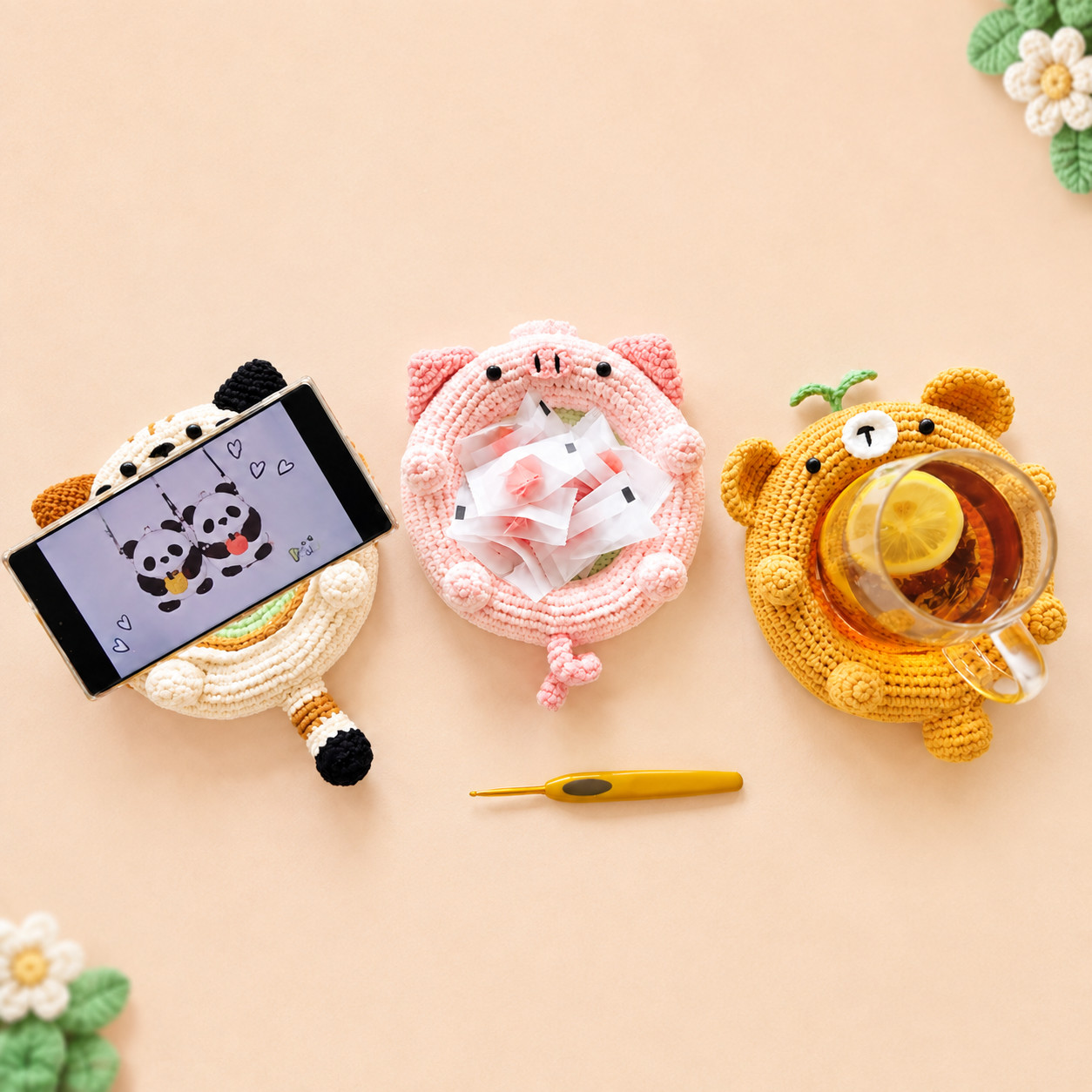
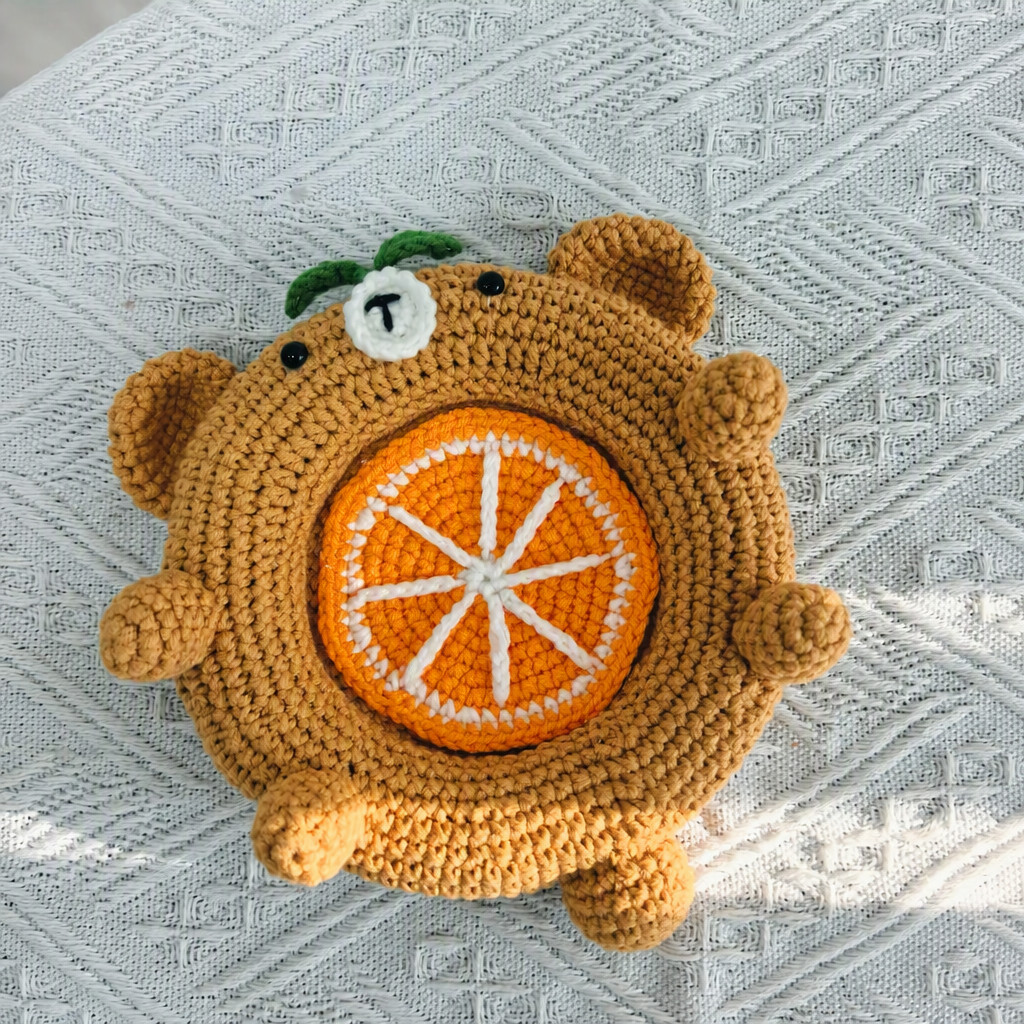
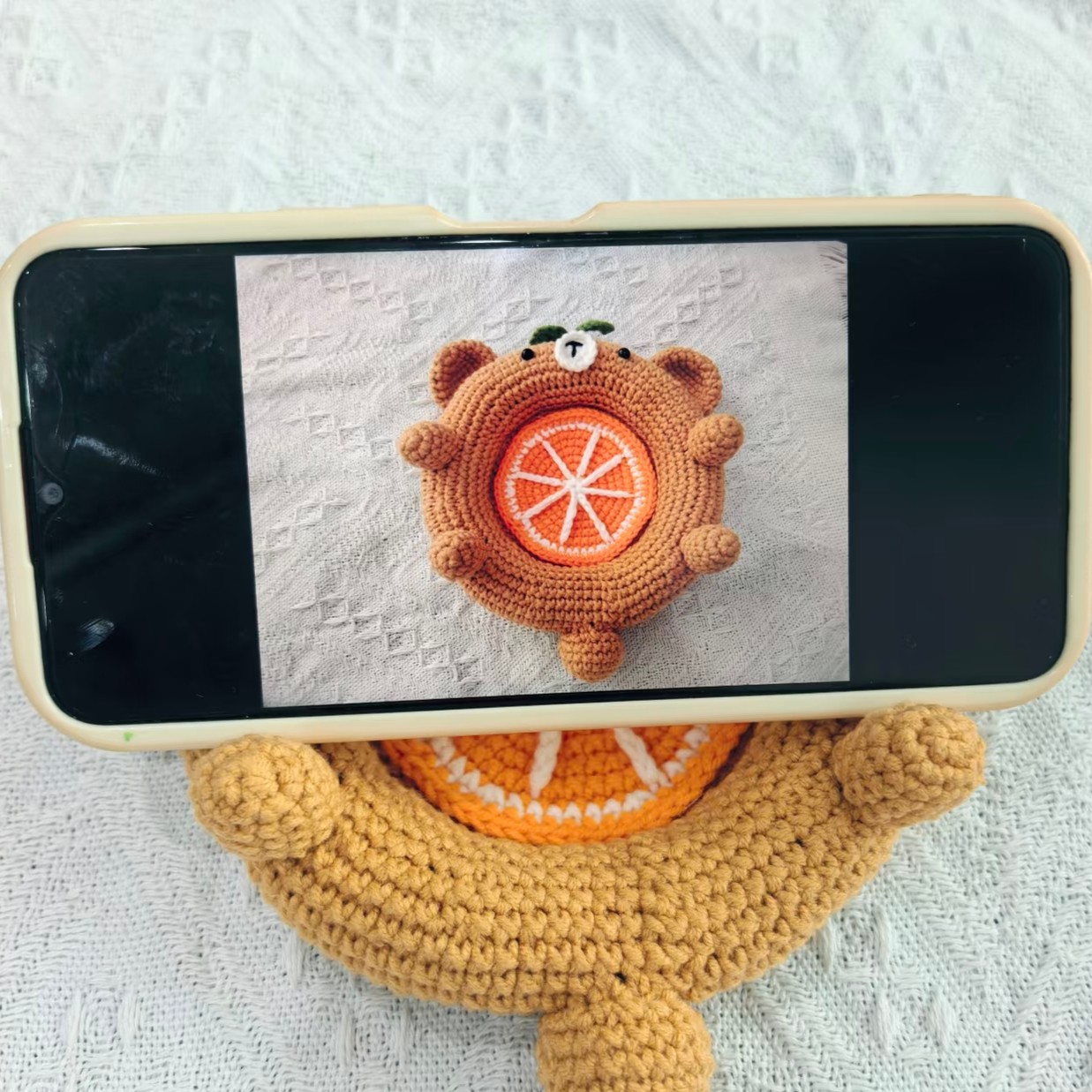
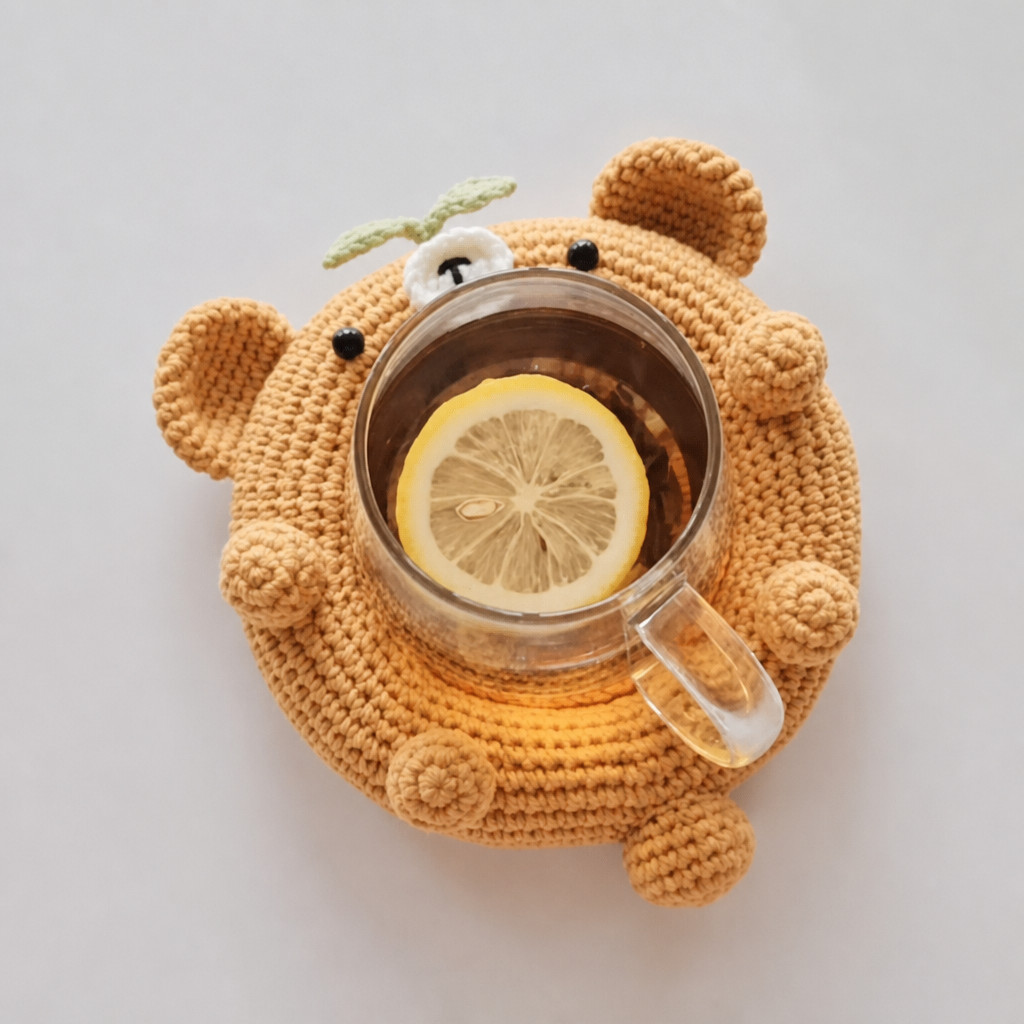
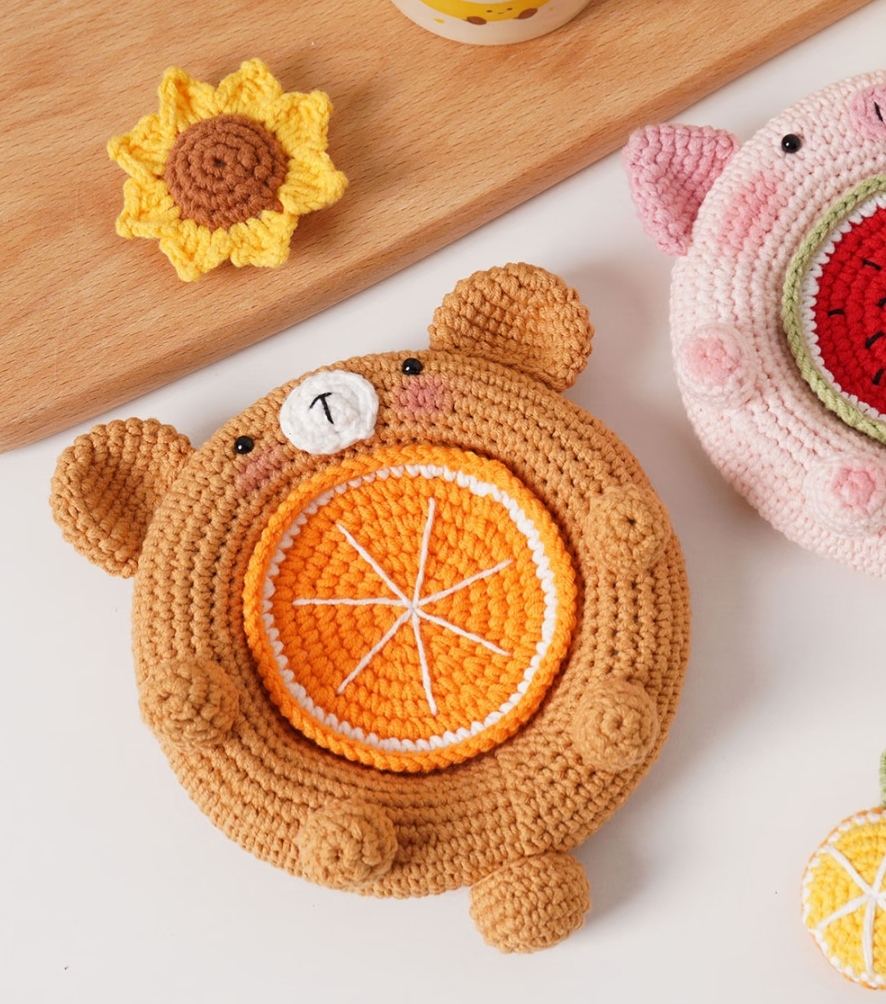
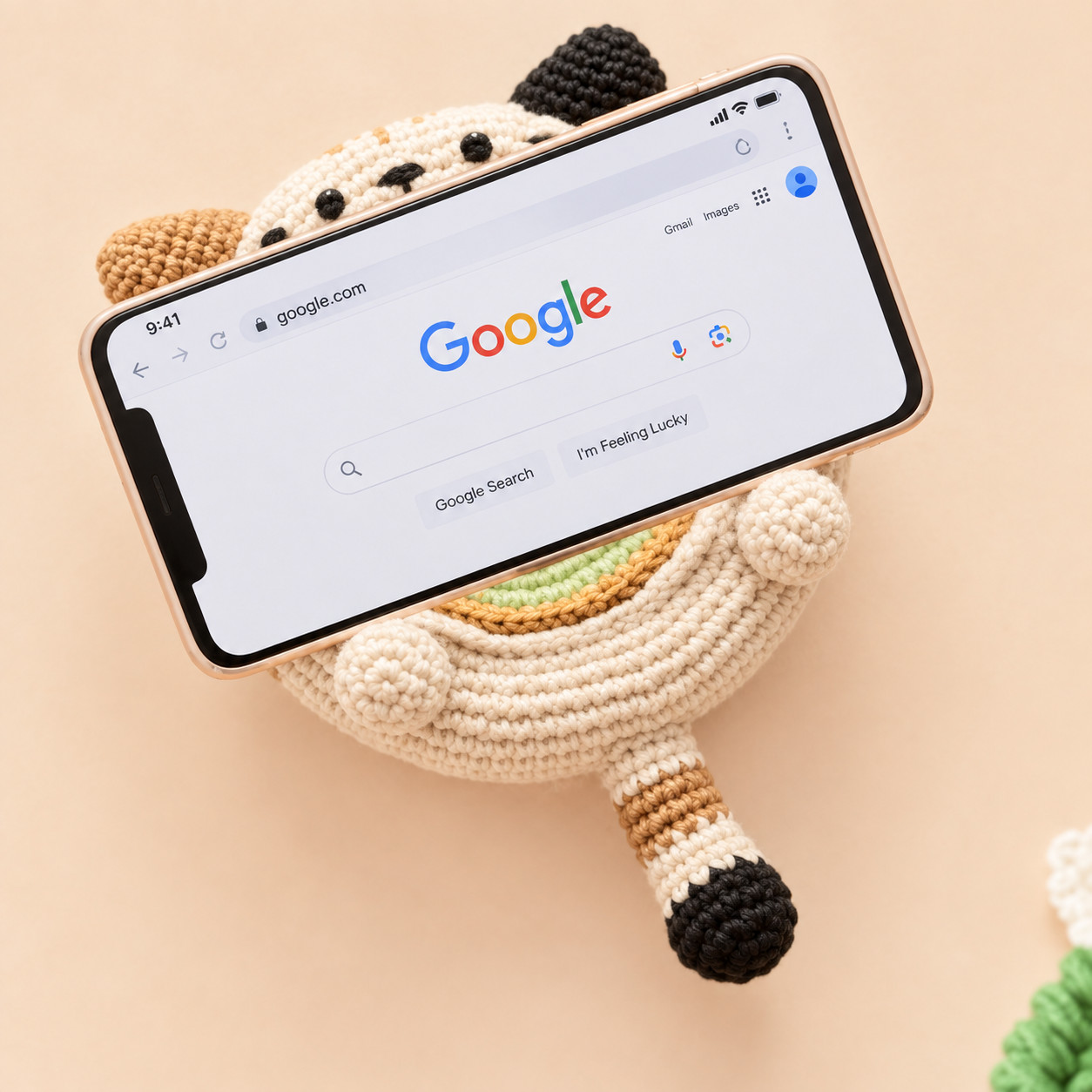
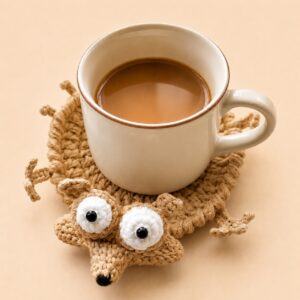
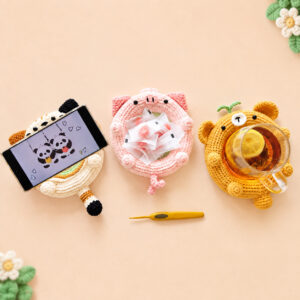
| What you make | A little dish with arms that holds your cup. A bowl worked in one piece with a padded rim, four paws holding the rim, two ears on a raised band at the back, and a crocheted fruit slice sitting in the well as the coaster. Your cup goes down inside it. In the photos it also props up a phone and holds a handful of sweets. |
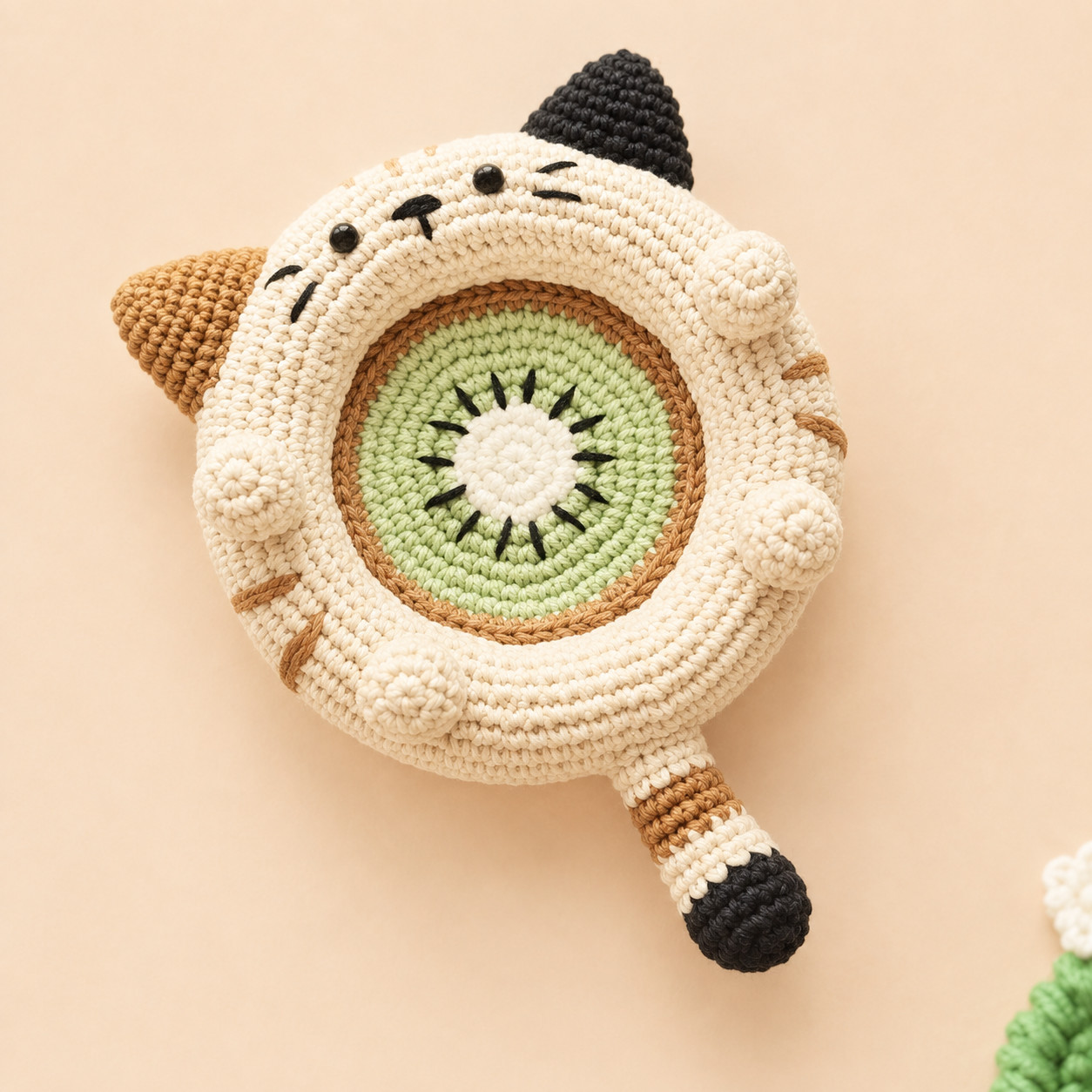
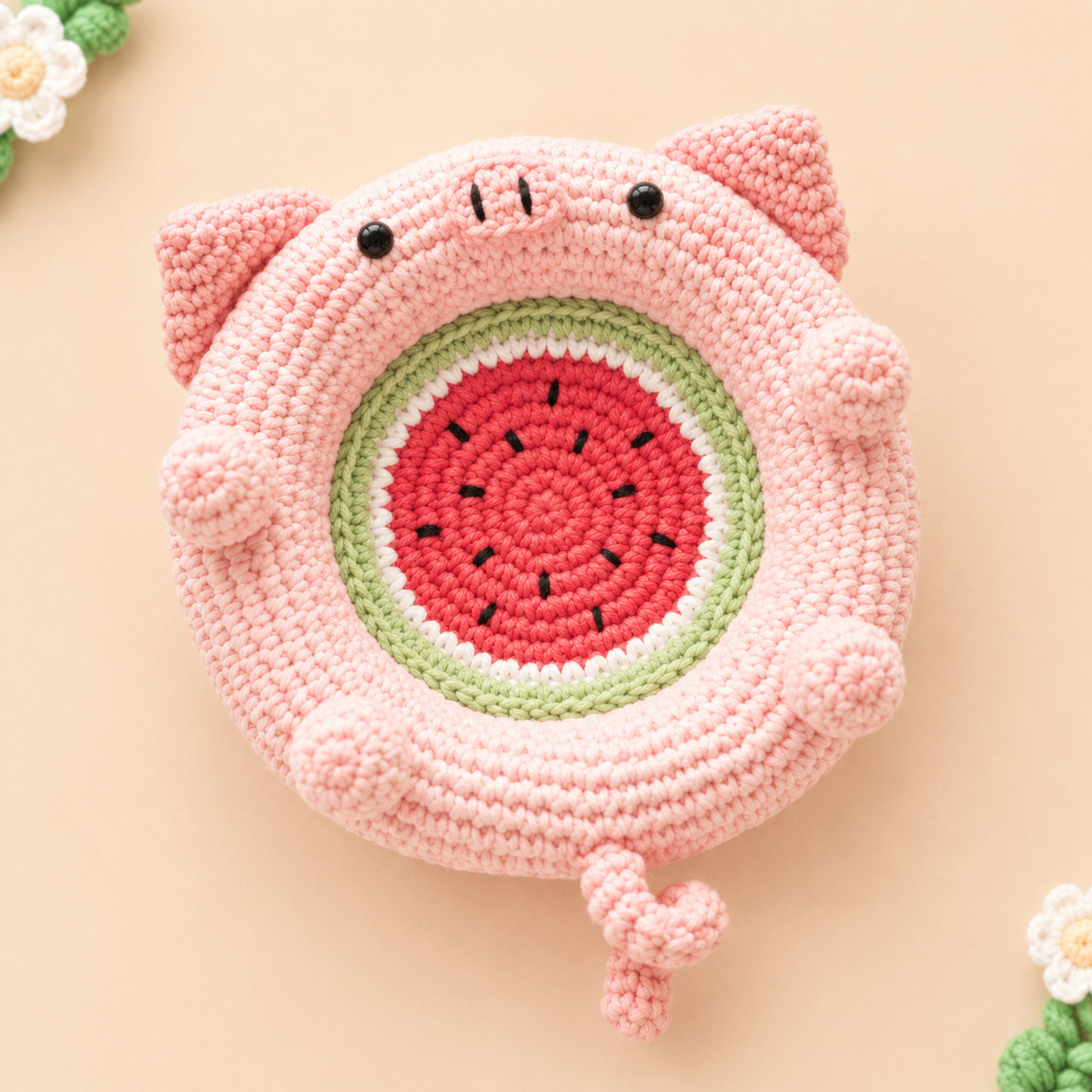
| Three animals, one pattern | The bear, the cat and the pig use the same bowl and the same four legs, stitch for stitch — 32 of the 103 rounds. Each animal has its own ears and its own tail. The bear and the pig each have a crocheted nose; the cat has none, and gets whiskers and stripes stitched on in black yarn instead. The bear also gets a pair of leaves. |
| Hook | 3.0 mm |
| Yarn | 5-ply milk cotton, worked deliberately tight. A main colour for the bowl, the legs, the ears, the tail and the nose; white for rounds 1 and 8 of the fruit slice; your own fruit colours for the rest of the slice; a little green for the bear’s leaves; and a little black for the eyes and the cat’s and pig’s face markings. |
| Using a different yarn | Keep the relationship, not the label: a yarn one weight heavier than your hook is rated for, worked firmly. Anything in the DK to light-worsted range on a 3.0 mm hook behaves the same way. On a 3.5 mm or 4.0 mm hook the stitch counts still work — you get a larger, floppier dish, and the rim wants more stuffing to hold its shape. |
| Check your fabric first | Work the first six rounds of the bowl and hold the disc up to a lamp: you want no daylight through it. The rim is a stuffed channel, and stuffing shows through a loose fabric as pale patches you can’t get at once the seam is closed. If light comes through, go down a hook size and start again. Six rounds is a cheap thing to lose. |
| Skill level | Confident beginner — one large piece in joined rounds, several small ones, and one seam that needs care. That is the pattern’s own wording, and the seam is the part to read through before you start. |
| Techniques used | Magic ring · joined rounds, each opened with a chain and closed with a slip stitch · starting from a foundation chain and working back along both sides of it · picking up the back bump of a chain · single crochet, half double crochet, chain and slip stitch · the yarn-under single crochet · the single crochet increase and the half double crochet increase · the invisible decrease · a spike stitch worked down into a much earlier round · trapping a length of wire inside a row of stitches · counting your stitches at the end of every round · sewing one round of a piece to an earlier round of the same piece · stuffing a channel as you sew it shut · adding eyes · sewing or gluing pieces together · fastening off and weaving in ends |
| Worked in | Joined rounds, not a spiral: one chain to start each round, never counted as a stitch, and a slip stitch into that round’s own first real stitch to close it. The pattern explains what goes wrong if you count the chain. The leaves and the pig’s nose are worked around both sides of a short chain instead, and the pig’s thin tail can be worked in a spiral if joined rounds fight you. |
| Number of pieces | Twelve for the bear: the bowl, four legs, two ears, a tail, a nose, two leaves and a fruit slice. Nine for the cat, ten for the pig. |
| Numbered rounds | 103. Twenty-seven for the bowl, five for a leg, nine for the fruit slice, and the rest across the three animals’ ears and tails and the bear’s nose. A leg is made four times and counted once. The leaves and the pig’s nose have no rounds; they are written out step by step. |
| Count checkpoints | Eleven. Five in the bowl alone — at the end of rounds 6, 12, 16, 21 and 27 — and one each in the bear’s ears, the bear’s tail, the fruit slice, the cat’s ears, the cat’s tail and the pig’s ears. Each one gives you the number you should have, and what to check if you don’t. |
| The bowl | Twenty-seven rounds in one piece. Rounds 2 to 6 add seven stitches each and the disc stays flat: 7, 14, 21, 28, 35, 42. From round 7 the increases drop to six, and that one change starts the wall climbing: 48, 54, 60, 66, 72, 78. Rounds 17 to 21 are five plain rounds of 96, and rounds 22 to 27 run rounds 16 to 11 backwards, decreasing where those rounds increased. The pattern flags round 7 before you start, and again when you reach it. |
| The head band | Rounds 13 and 25 both read 28 sc, 22 hdc, 28 sc and both stay at 78 stitches. Nothing is added or taken away — the 22 taller stitches raise a shallow arc in the wall, twelve rounds apart, and that arc is the head. The eyes, the nose and the ears go on it. |
| The rim | The bowl does not get fastened off. You finish round 27 with 66 stitches and the working yarn still attached, fold that round down inside the bowl until it meets round 10, and sew the two rounds together — stuffing the channel a third at a time as you go, never ahead of the needle. What you end up with is a padded roll all the way round the rim and a dish open in the middle. The pattern gives this seam its own three-step walkthrough, with a photo. |
| The fruit slice | Nine rounds, joined like the bowl. Rounds 1 and 8 are white; the rest are your fruit colours. Round 8 is seven single crochets and then a spike stitch — five wraps on the hook, reaching all the way down around a stitch of round 1 — seven times over. Those seven spikes are the white segment lines of a citrus slice. A spike takes nothing from the round below, which is why round 8 gains seven stitches while using only the 49 that round 7 gave you. The seeds are sewn on afterwards in black yarn. The photos also show a kiwi on the cat and a watermelon on the pig; those have no segment lines, and that version is not written out — the slice in the file is the citrus one. |
| Stuffing | The rim channel only. The pattern tells you not to stuff the bowl, the ears or the legs. |
| Sewing | Yes. The rim is a sewn seam. Then four legs, two ears and a tail are sewn to the bowl, plus a nose on the bear and the pig. The bear’s leaves go on beside one ear — sew the stem down, or push the wire through and twist it off inside. The fruit slice is sewn or glued into the well. |
| Wire | A short length of fine craft wire, worked inside the bear’s leaves and the pig’s tail so they hold whatever curve you bend into them. |
| Also needed | Two small dark eyes — safety eyes, small black beads or a few stitches of black yarn all give the same result at this size, and the pattern doesn’t depend on which you pick. Two stitch markers, a tapestry needle, a little stuffing, fine craft wire and scissors — and a hot glue gun only if you’d rather glue the fruit slice in. |
| Glue | Optional, and only in one place: the fruit slice can be glued into the well or sewn round its edge. Glue is faster; sewing survives a wash. Every other join in the pattern is sewn. |
| Terminology | US crochet terms |
| Language | English |
| Pages | 31 |
| Left-handed | Written for you too. Work it exactly as written — every round has the same stitches and the same count, and your pieces come out as mirror images of the photos. Nothing in this pattern is a mirrored pair: both ears, all four legs and both leaves come off one set of instructions, and which way they face is decided when you lay them out. The spike stitch is a reach, not a direction; the only visible difference is that the seven segment lines spiral the other way. |
| Delivery | Download link on the confirmation page and in your email, straight away. |
Real crochet, captured while it was being made
You have learned to zoom in on a listing photo looking for stitches that don’t join up. You should — the shops selling patterns behind pictures that were never crocheted are real, and there are a lot of them.
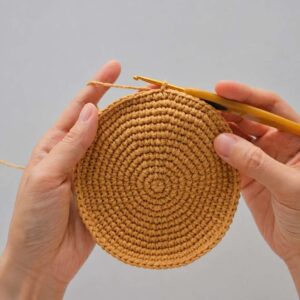
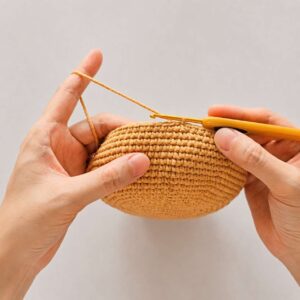
So here is the unglamorous version: the bowl as a flat disc with the hook still in it, the bowl with its wall standing up, and the rim rolled over with the stuffing showing inside it. Every one of these was captured while the piece was actually being made.
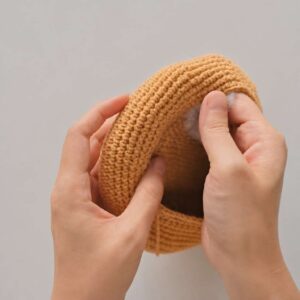
The rim is the one to look at. That roll is what the whole object is: the bowl’s last round folded down inside and sewn to round 10, stuffed a little at a time as it closes. It is the least photogenic step in the pattern, and it is the step that turns a wall into a padded rim.
Nothing on this page is an AI-generated coaster.
Counted twice
My grandmother taught me on her porch, and she said the same thing every time I tangled the yarn: slow down, count twice, rip it out if it’s wrong — there’s no shame in starting over.
So every pattern in this shop gets counted twice. Once when it’s written. Then again, before it goes on sale: every round is re-added, stitch by stitch, and checked against the round before it.
That’s the whole thing. It’s not clever. It is just the step almost nobody takes, because until a pattern is written down properly you can’t take it — and because nobody was ever asked to show their working.
I’m asking to show mine.
The worst thing a pattern does is not be difficult. It is to be wrong early, so that you find out several rounds later and spend the next twenty minutes wondering whether it was you. It usually wasn’t you. But you can’t tell, and that not-being-able-to-tell is the part that makes people put the hook down.
On this one the likeliest place for that is round 7 of the bowl. Rounds 2 to 6 add seven stitches each. Round 7 drops to six, and it is one line that looks like nothing. Work it with seven and you get 49 instead of 48 — close enough to feel right, and wrong enough that round 8’s groups will not divide. Every round from 7 to 16 depends on it, which is why the pattern warns you before you start, and again the moment you reach it.
Counted twice means you can tell. No more counting the same round for the third time, writing it out on paper to make it add up, and still not knowing whether it’s you or the pattern. The count in the pattern is right. If yours doesn’t match it, the slip is in the round you just made — undo that one round and carry on.
You probably have one project in a bag somewhere, stopped at a round you can still name. Often it stopped on a count that wouldn’t come out. Every count in this one comes out, which leaves you the part you came for: finishing it, and handing it to someone without an apology.
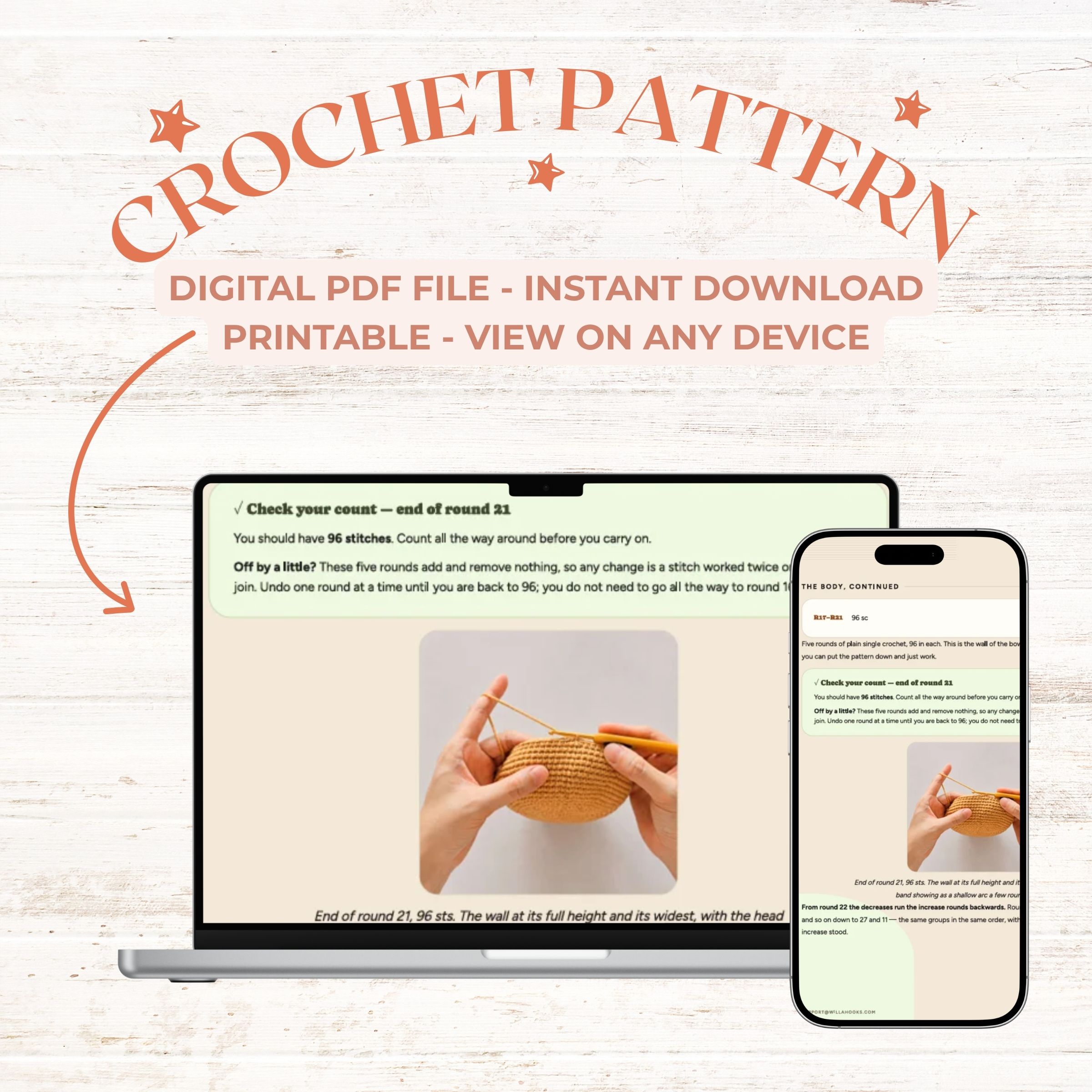
Here is a real page of it
A pattern that was never crocheted can show you a photograph. It cannot show you a page.
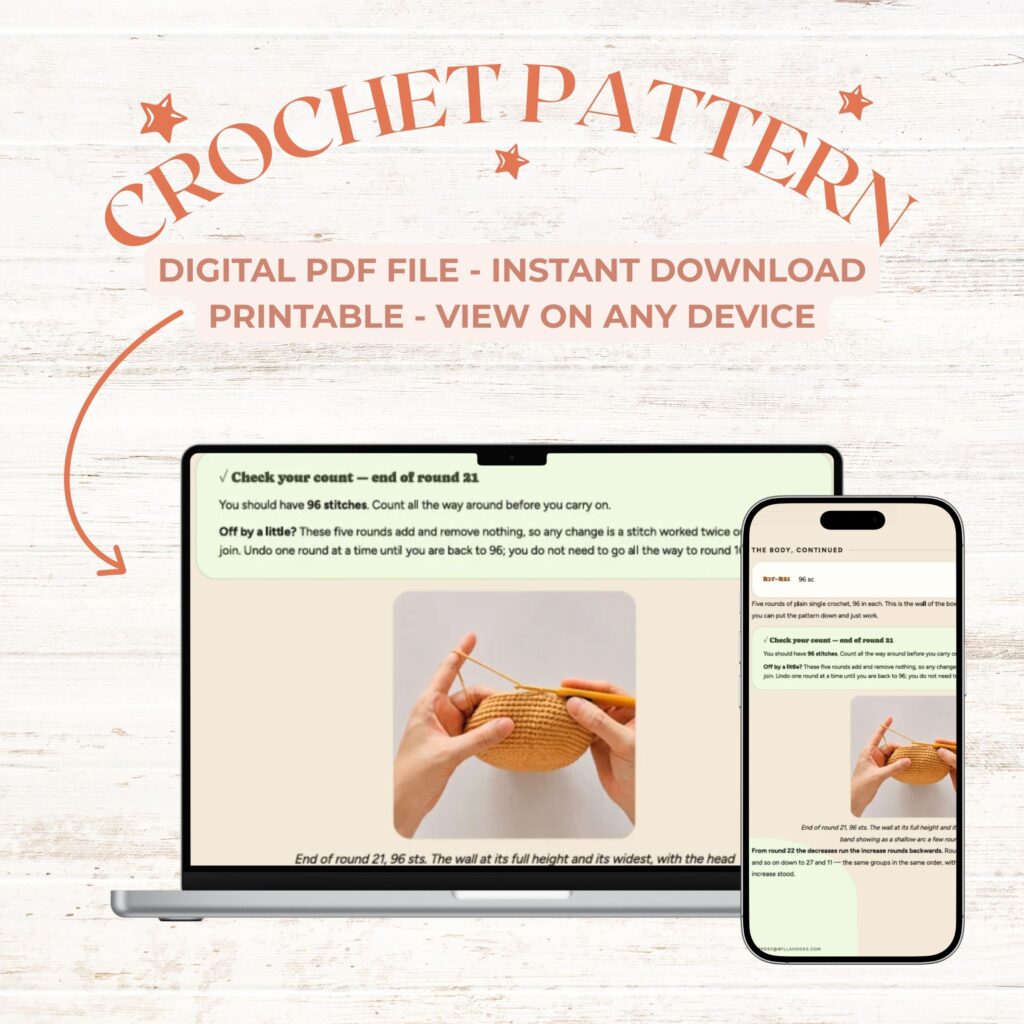
That green box is a count checkpoint, and it is the first one you meet: the end of round 6 of the bowl, where you should have 42 stitches. Every round above it carries its total in brackets — 7, 14, 21, 28, 35, 42 — and if yours doesn’t match, the box tells you what has usually gone wrong and which round to undo to. A few lines under it, in bold, is the warning about round 7. There are eleven of these boxes through the pattern, at the rounds where a miscount actually shows up. This is page 12 of the 31 you get, and it is the same page you will be reading with a hook in your hand.
Reviews
There are no reviews yet.