
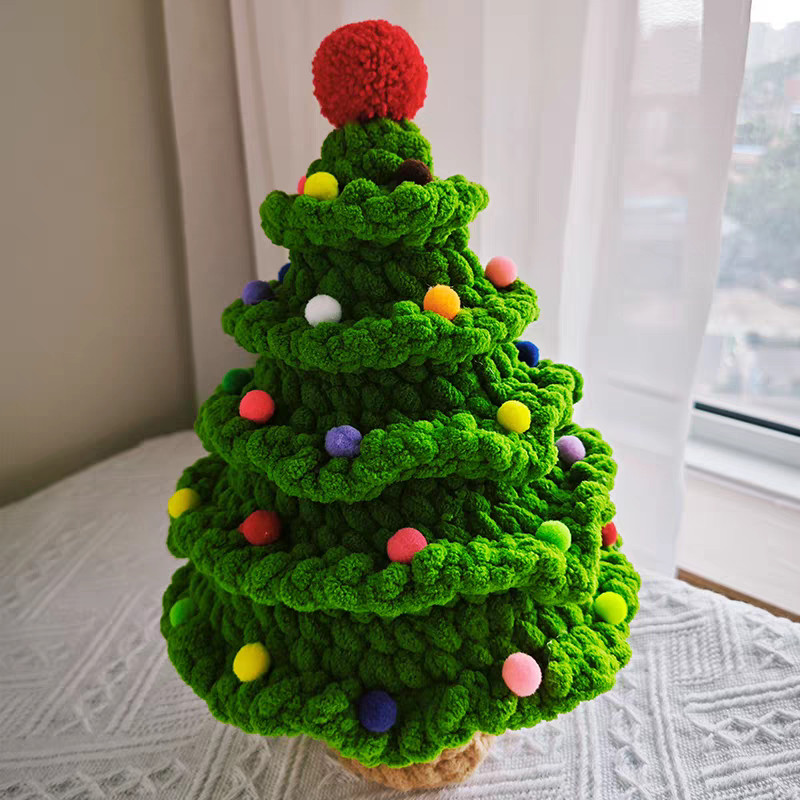
Everything about this pattern, before you pay for it
Most pattern listings tell you after. Here is the whole spec.
| What it is | A written crochet pattern, delivered as a PDF. The file itself is titled The Frilled Christmas Tree. |
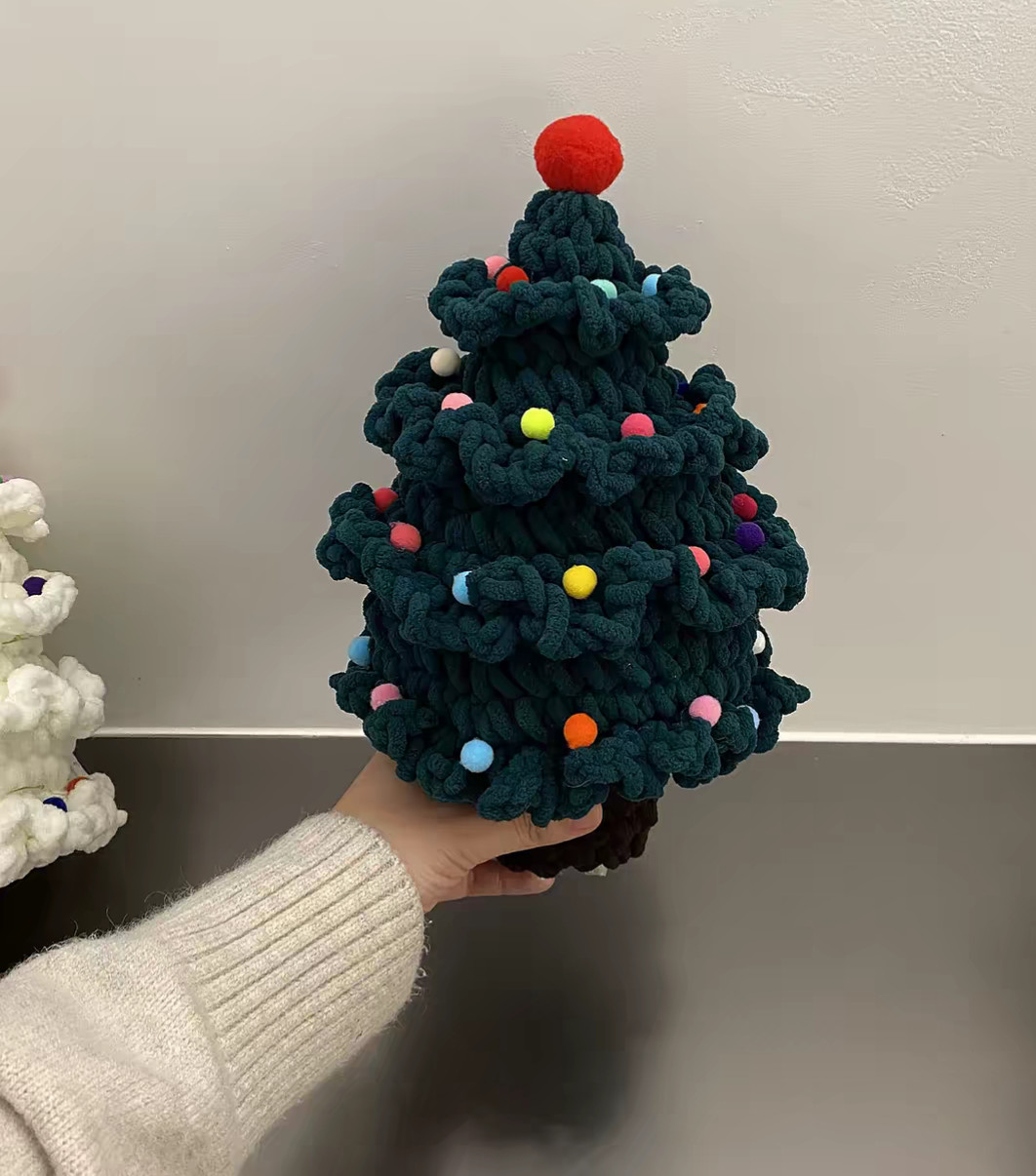
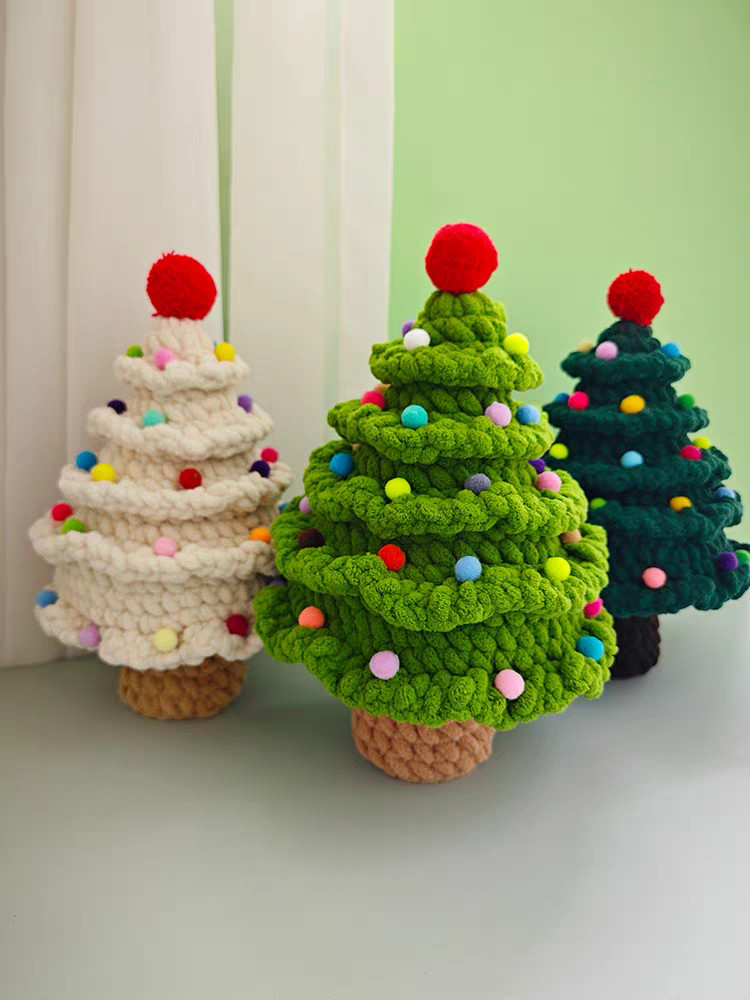
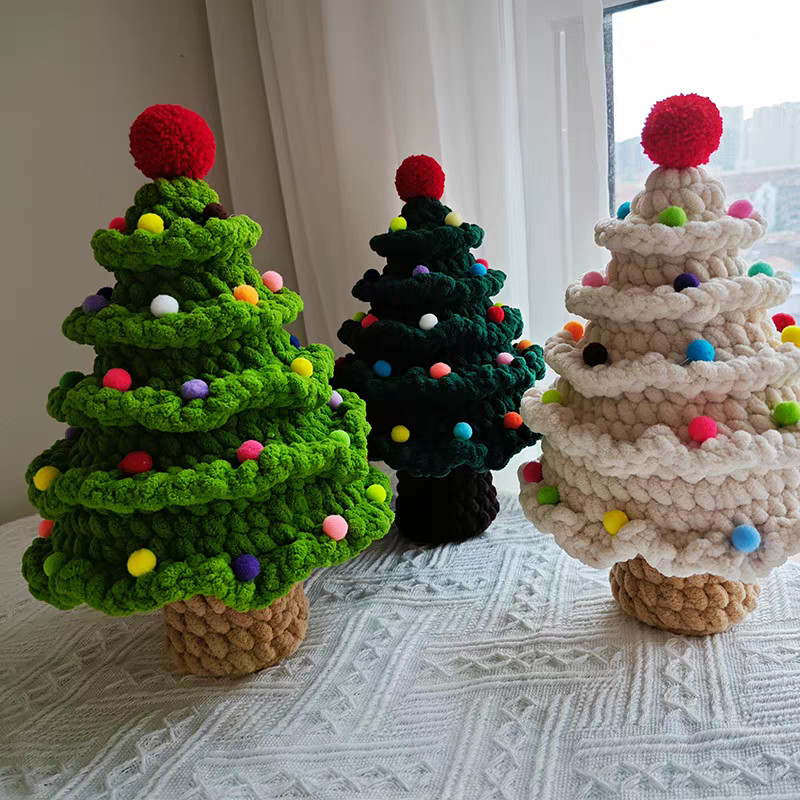
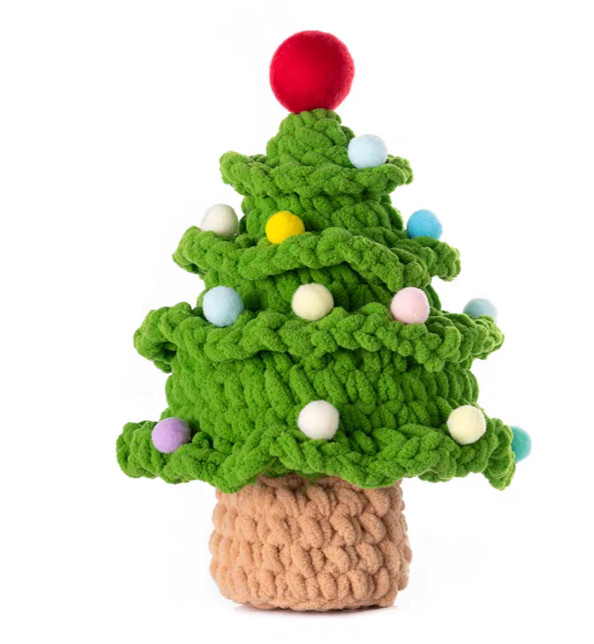
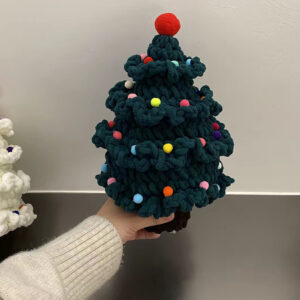
| What you make | A plump, stuffed tabletop Christmas tree in green chenille with four tiers of ruffled frills, standing on a short brown trunk, with small pompoms scattered over it and a big red pompom on top. |
| Finished size | About 20 cm (8 in) tall with the top pompom, and about 17 cm (6¾ in) across the lowest frill. |
| How long it takes | About 1½ hours. |
| Hook | 6.0 mm. |
| Yarn | Chunky chenille — a thick, soft yarn with a velvety pile, roughly a US bulky (5) — in green and brown. |
| Yarn needed | About 86 g (75 yd) of green and 11 g (10 yd) of brown — about 97 g (85 yd) in all. Chenilles differ in weight, so the yards are the surer figure. |
| Other sizes | The pattern has a table for two more: a slightly thinner chenille on 5.0 mm makes a tree about 17 cm (6¾ in) tall with about 70 yd; jumbo chenille on 8.0 mm, about 27 cm (10½ in) with about 115 yd. The stitch counts stay the same. |
| Skill level | Beginner, which is what the pattern itself says: joined rounds, increases and decreases, working into one loop only, and some sewing and gluing. |
| Techniques used | Starting with a magic ring · joined rounds, closing each one with a slip stitch · single crochet and half double crochet · the single crochet increase and decrease · working into the back loop only, and later into the front loops left free · joining new yarn to a piece and working a frill round · stuffing, sewing two pieces together edge to edge, and gluing on pompoms |
| Worked in | Joined rounds: slip stitch into the first stitch, chain 1, and start the next round in that same stitch. The chain never counts as a stitch. |
| The tree | Fourteen rounds, from the tip down. It grows by three stitches every round, from 6 to 39 at round 12, then closes in two rounds to 13. Rounds 4, 7, 10 and 13 go into the back loops only, and each leaves a ring of free front loops on the round before it. |
| The frills | Four, one in each ring of free loops: 12, 21, 30 and 39 single crochets, with two chains between each — the chains are what make it ruffle. Start each one below the start of the one above, and the joins line up at the back. |
| The trunk | A small brown cup: 12 half double crochets in a ring, turned up with a back-loop round, then three plain rounds. A few small pebbles in the bottom make the tree steadier, if you like. |
| Number of pieces | Two crocheted pieces, the tree and the trunk, plus four frills worked onto the tree. |
| The decoration | About 15 small pompoms, about 1.5 cm (⅝ in) across, in mixed colours — about six on the lowest tier and fewer on each tier above — and one red pompom about 4 cm (1½ in) across for the top. |
| Working with chenille | Chenille’s pile hides the stitches, so the pattern keeps a marker in the first stitch of every round, and has you pull the loop up a little taller on rounds 3, 6, 9 and 12 so the back loops are easy to find on the round after. And a check for the fabric: stretch a round gently, and if you can see the fiberfill through it, go down a hook size. |
| Count checkpoints | Six: 12 at the end of the trunk’s round 2; 12, 21, 30 and 39 at the ends of the tree’s rounds 3, 6, 9 and 12; and 13 at round 14. |
| Sewing and glue | The trunk is sewn to the bottom of the tree with its own tail. The frills are crocheted on, and the pompoms are glued on with hot glue. |
| Also needed | About 30 g of fiberfill, the pompoms, a hot glue gun, a few stitch markers and a yarn needle. |
| Pages | 16 |
| Printing | The instructions are real text, not pictures of text — so you can search them, copy them, enlarge them, or have them read aloud. |
| Terminology | US crochet terms |
| Language | English |
| Left-handed | Written for you too. Work it exactly as written: every round has the same stitches and the same count, you are simply working in the other direction. The back loop is still the one farther from you, so the back-loop rounds don’t change. |
| Delivery | Download link on the confirmation page and in your email, straight away. |
Real crochet, captured while it was being made
You have learned to zoom in on a listing photo looking for stitches that don’t join up. You should — the shops selling patterns behind pictures that were never crocheted are real, and there are a lot of them.
So here is the unglamorous version: the tree before its frills, a plain green cone held in two hands with the hook still in one of them; a frill going on, seen from above; and the tree with all four frills on, before the pompoms. Every one of these was captured while the piece was actually being made.
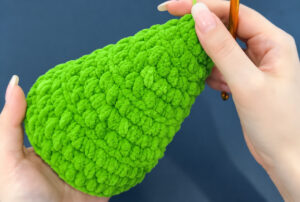
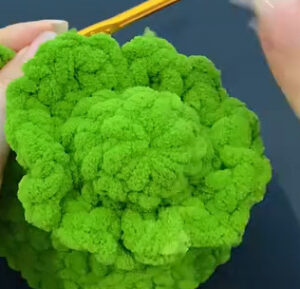
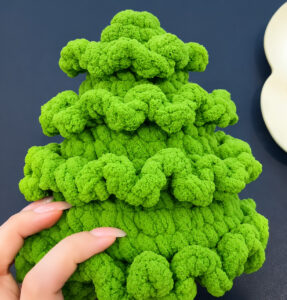
The tree before its frills is the one to look at. It is a plain green cone and nothing else — every ruffle on the finished tree is crocheted onto it afterwards, into rings of loops left free on the way down.
Nothing on this page is an AI-generated tree.
Counted twice
My grandmother taught me on her porch, and she said the same thing every time I tangled the yarn: slow down, count twice, rip it out if it’s wrong — there’s no shame in starting over.
So every pattern in this shop gets counted twice. Once when it’s written. Then again, before it goes on sale: every round is re-added, stitch by stitch, and checked against the round before it.
That’s the whole thing. It’s not clever. It is just the step almost nobody takes, because until a pattern is written down properly you can’t take it — and because nobody was ever asked to show their working.
I’m asking to show mine.
The worst thing a pattern does is not be difficult. It is to be wrong early, so that you find out rounds later and spend the next twenty minutes wondering whether it was you.
On this tree, the likeliest place for that is round 12, and the reason is the yarn. Chenille’s pile hides the stitches, so a missed increase is hard to see. The tree grows by three stitches every round, and round 12 is the last and widest, at 39. Round 13 then works a plain stitch and a decrease thirteen times, which takes exactly those 39, and the bottom frill goes into round 12’s free loops, one single crochet in each. So round 12 ends on a checkpoint, and if you are three short, it tells you why: the round was worked plain.
Counted twice means you can tell. No more counting the same round for the third time, writing it out on paper to make it add up, and still not knowing whether it’s you or the pattern. The count in the pattern is right. If yours doesn’t match it, the slip is in the round you just made — undo that one round and carry on.
You probably have one project in a bag somewhere, stopped at a round you can still name. Often it stopped on a count that wouldn’t come out. Every count in this one comes out, which leaves you the part you came for: finishing it, and standing it on the table before Christmas.
Here is a real page of it
A pattern that was never crocheted can show you a photograph. It cannot show you a page.
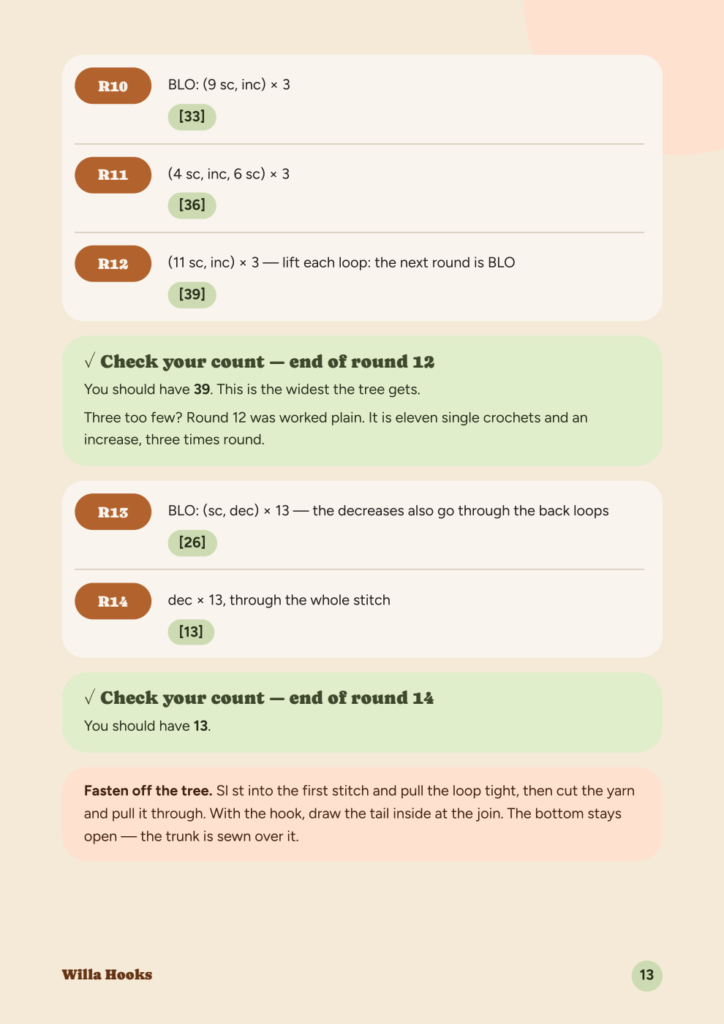
The first box on it is the end of round 12: 39 stitches, the widest the tree gets. If you have three too few, it tells you why — the round was worked plain, and it should be eleven single crochets and an increase, three times round. This is page 13 of the 16 you get, and it is the same page you will be reading with a hook in your hand.

Reviews
There are no reviews yet.