
Everything about this pattern, before you pay for it
Most pattern listings tell you after. Here is the whole spec.
| What it is | Two written crochet patterns, each a PDF: the coaster, and a little flower pot to stand it in. The files are titled The Lily of the Valley Coaster and The Little Flower Pot. |
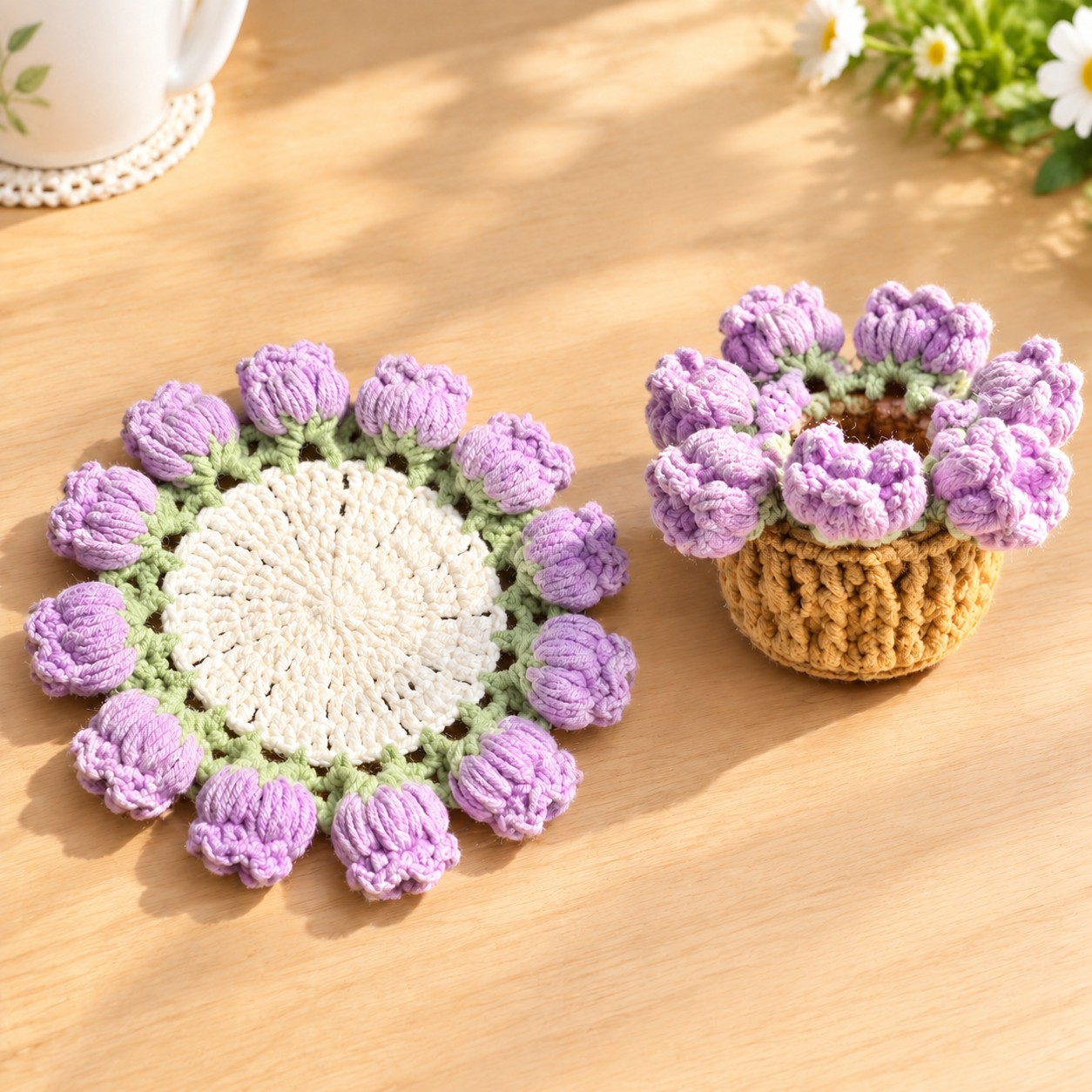
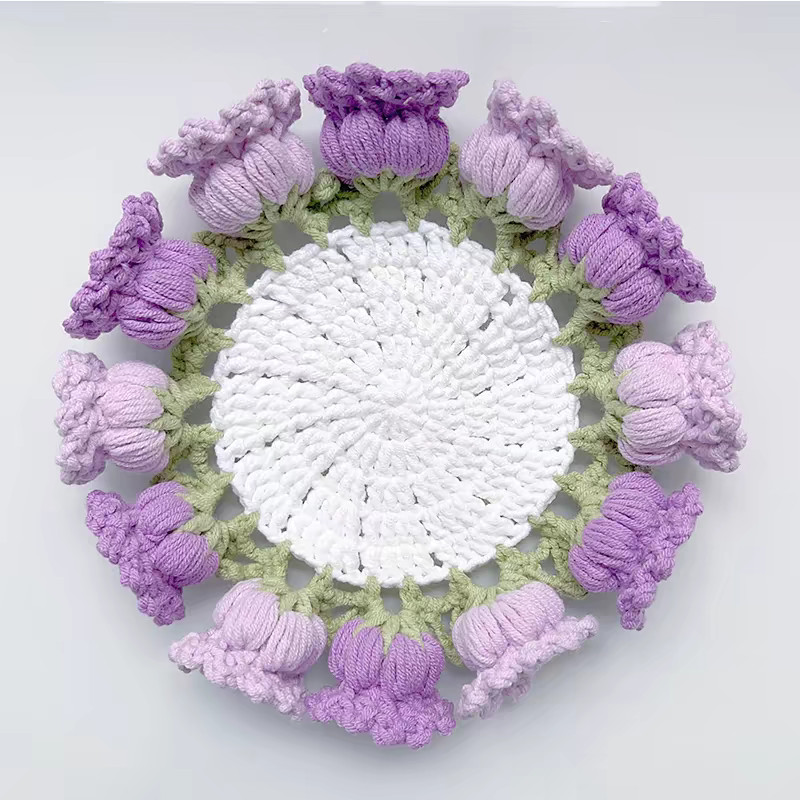
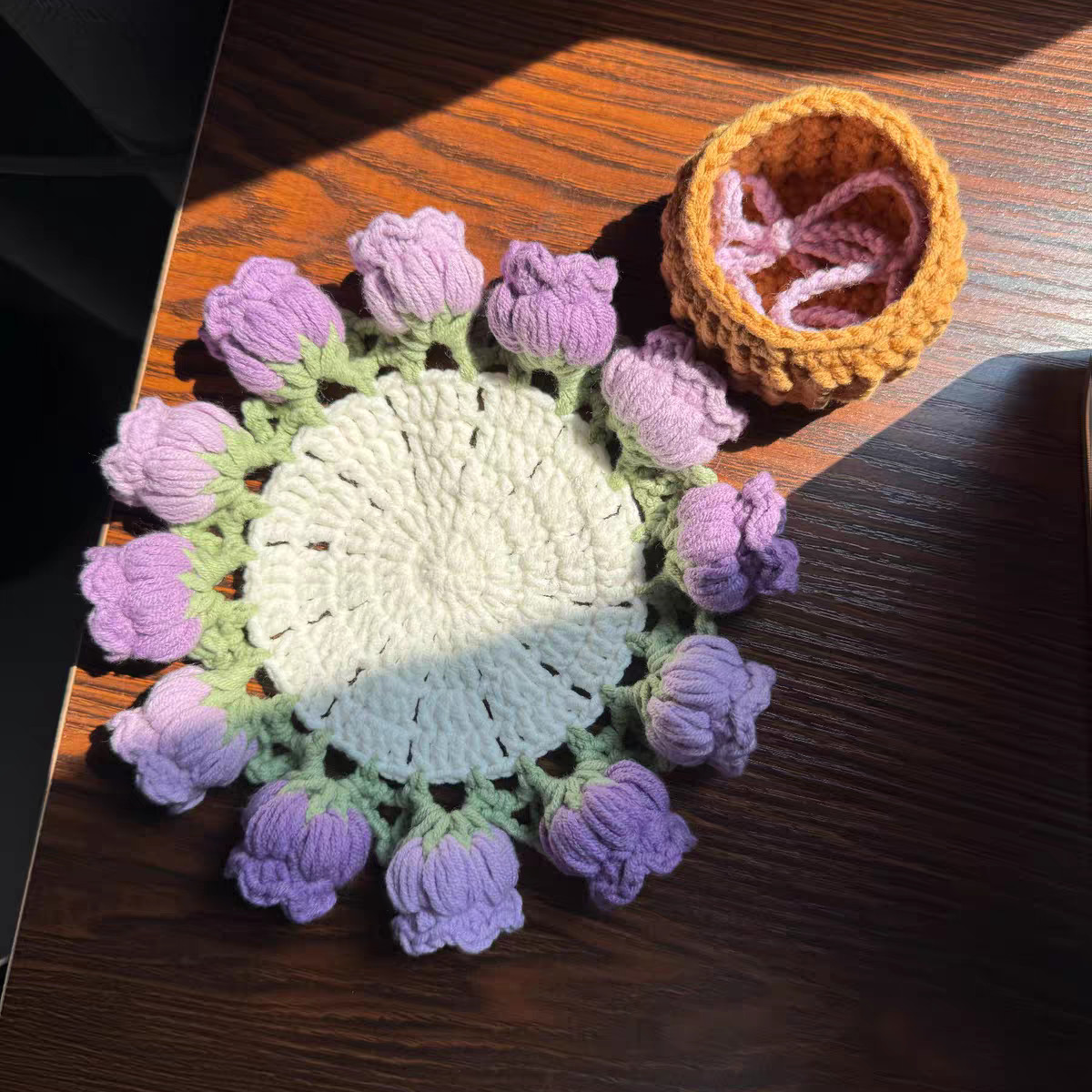
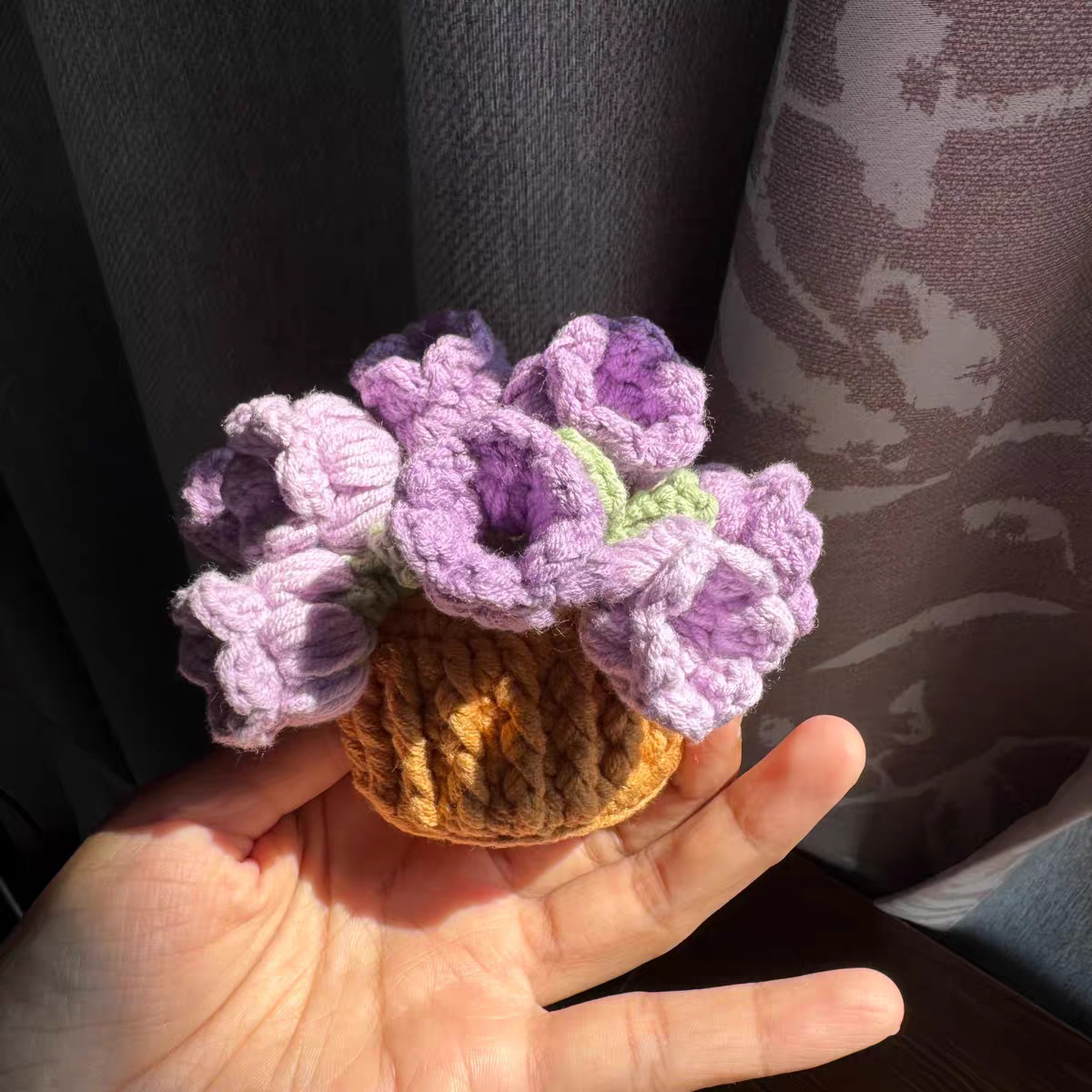
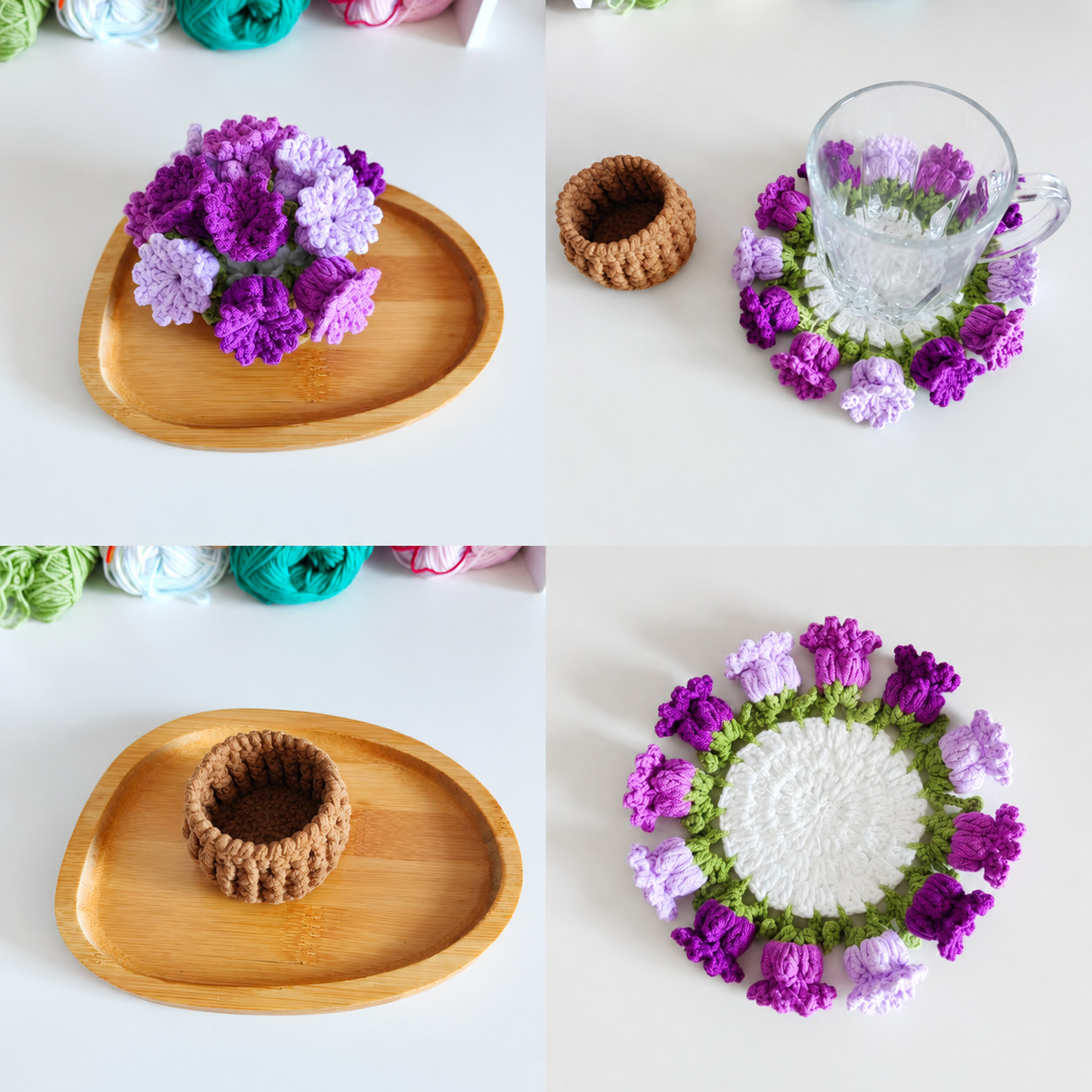
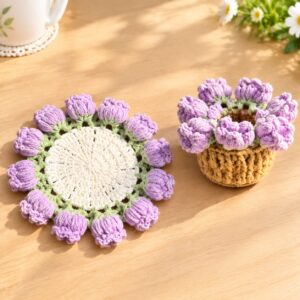
| What you make | A round openwork coaster: a white centre with twelve spokes of little holes, a green edging of flat scallops and pointed leaves, and a lily of the valley on every scallop — a small bell of five clusters with a ring of picots at its rim. Fold it in half and tuck it into the flower pot, and it is a small bouquet. |
| Two sizes | Five centre rounds and 12 lilies, or six centre rounds and 14. The extra round is written out, and the pattern gives the loop, scallop and lily counts for both. Sizes and yarn for each are in the table below. |
| Finished size | About 19 cm (7½ in) across the lilies. The white centre, where the cup sits, is about 10 cm (4 in). The pot is about 6.5 cm (2½ in) across and 5.5 cm (2¼ in) tall. |
| How long it takes | About 2½ hours for the coaster, about 3 for the larger size. About 1 more for the pot. |
| Hook | 2.5 mm for the coaster — the only hook in its pattern. 3.0 mm for the pot. |
| Yarn | 4-ply milk cotton, about a US sport weight, in three colours: white for the centre, green for the edging, and a colour for the lilies. Each lily is joined on its own, so they can all be one colour or each a different shade. The pot is one colour of 5-ply milk cotton, about a US DK weight; a strong colour shows its ribs best. |
| Yarn needed | About 9 g (20 yd) of white, 8 g (20 yd) of green and 24 g (60 yd) for the lilies — about 41 g (100 yd) in all. One 50 g ball of each colour covers either size. The pot takes about 18 g (40 yd). |
| Skill level | The coaster is confident beginner, which is what its pattern says: joined rounds, working into chain spaces, clusters and picots. The pot is advanced beginner, as its pattern says: post-stitch ribbing, invisible decreases and a reverse single crochet rim. |
| Techniques used | Magic ring · joined rounds, closing each one where it began · chain, slip stitch, single crochet and double crochet · the double crochet increase · skipping a chain space so it stays open as a hole · working several stitches into one chain loop · a pointed leaf made of chains and a slip stitch · the 5-dc cluster · a picot closed into the side of a stitch · changing colour for each new part · weaving in ends. The pot adds: working into the back loops only · front and back post double crochet · the single crochet increase · the invisible decrease · reverse single crochet · an invisible finish |
| Worked in | Both in joined rounds, from the centre out. The ch 2 that starts each round of the centre never counts as a stitch, and every round says so: round 1 is twelve double crochets after it, not eleven. |
| The centre | Five rounds, each of twelve groups of double crochet with a chain-1 hole after every group. Each round, every group grows by one stitch. The holes are stepped over on the next round, so they stack into twelve straight spokes. |
| The edging | Two rounds, worked straight onto the centre. Round 6 throws a ring of 24 chain-5 loops (28 on the larger size), and here the holes of the centre count as stitches. Round 7 turns the loops, in pairs, into a flat scallop and a pointed leaf, all the way round. |
| The lilies | Worked straight onto each flat scallop: one cluster in each of its five spaces, folded shut into a bell with a slip stitch, then ten picots round the rim. The leaf points carry no lily. |
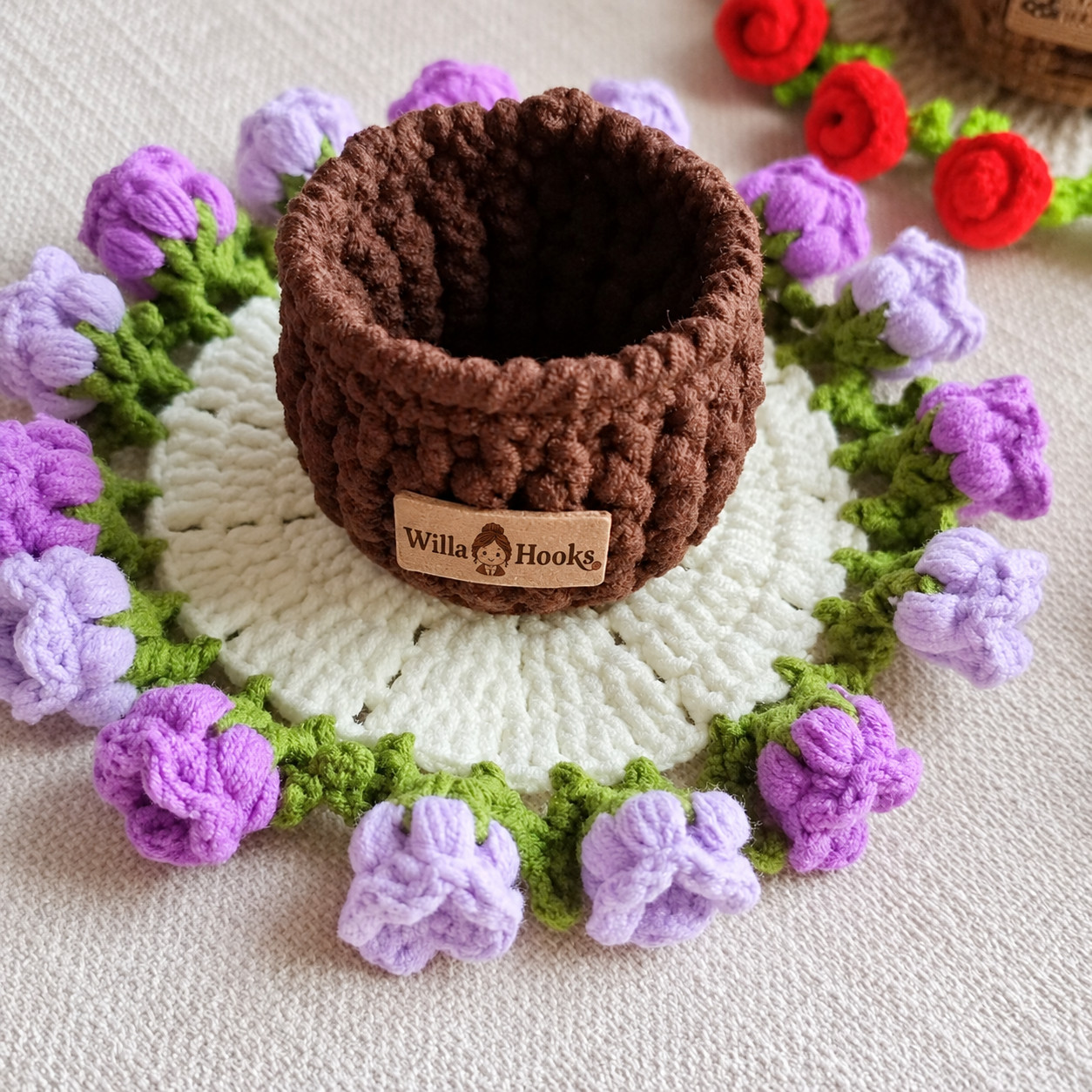
| The flower pot | A flat round base of five rounds, turned up with one round in the back loops, three rounds of front and back post ribbing, then drawn in and finished with a corded rim — one piece, one colour. Tuck the folded coaster into it and the lilies stand round its rim. |
| Going on to the blanket? | The Lily of the Valley Bouquet Blanket in this shop has the same leaf edging and the same lily, built the same way, around a body of 70 to 100 cm. Make this first, and by the time you reach the blanket’s edging you will already know both. |
| Sewing and glue | None, in either pattern. The edging is worked onto the centre and every lily onto the edging, and the pot is one piece. The only needle work is weaving in ends. |
| Ends | Each lily is joined and finished on its own. Its starting tail is worked in under the clusters as you go, so there is one end per lily to weave in, and it goes inside the bell, where it does not show. |
| Count checkpoints | Seven: 12 double crochets at the end of round 1; 48 at the end of round 3, which is twelve groups of 3 with their holes; 72 at the end of round 5; 84 at the end of round 6 on the larger size; 24 chain loops at the end of the edging’s first round; 12 scallops and 12 leaves alternating at the end of its second; and 5 clusters on each lily. Three in the pot: 16 at the end of round 2, 40 at the end of round 5, and 32 at the end of round 10. |
| Also needed | A stitch marker, a blunt yarn needle and scissors — the same for both. |
| Pages | 19 for the coaster, 15 for the pot |
| Printing | The instructions are real text, not pictures of text — so you can search them, copy them, enlarge them, or have them read aloud. |
| Terminology | US crochet terms |
| Language | English |
| Left-handed | Written for you too. Work it exactly as written and your coaster comes out a mirror image of the photos. Nothing else changes: the centre is twelve identical wedges, and the edging repeats the same pair all the way round. In the pot, the reverse single crochet rim travels from right to left for you. |
| Delivery | Both download links on the confirmation page and in your email, straight away. |
The coaster’s two sizes
| Small | Large | |
|---|---|---|
| Centre rounds | 5 | 6 |
| Lilies | 12 | 14 |
| Across, with the lilies | about 19 cm (7½ in) | about 21 cm (8¼ in) |
| The white centre | about 10 cm (4 in) | about 12 cm (4¾ in) |
| White | about 9 g (20 yd) | about 12 g (30 yd) |
| Green | about 8 g (20 yd) | about 10 g (25 yd) |
| Lily colour | about 24 g (60 yd) | about 27 g (70 yd) |
| All together | about 41 g (100 yd) | about 49 g (125 yd) |
| Time to make | about 2½ hours | about 3 hours |
Real crochet, captured while it was being made
You have learned to zoom in on a listing photo looking for stitches that don’t join up. You should — the shops selling patterns behind pictures that were never crocheted are real, and there are a lot of them.
So here is the unglamorous version: green chain loops going round the edge of the white centre, with the hook still in the work; a lilac lily’s clusters going into one of the green scallops; and a finished lily, a small bell with picots round its rim, standing up from the edging. Every one of these was captured while the piece was actually being made.
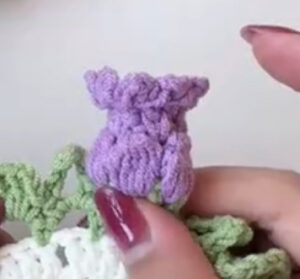
The lilies are the ones to look at. Each one is five clusters worked straight into the spaces of a scallop, then folded shut into a bell, so there is no flower to make separately and sew or glue on.
Nothing on this page is an AI-generated coaster.
Counted twice
My grandmother taught me on her porch, and she said the same thing every time I tangled the yarn: slow down, count twice, rip it out if it’s wrong — there’s no shame in starting over.
So every pattern in this shop gets counted twice. Once when it’s written. Then again, before it goes on sale: every round is re-added, stitch by stitch, and checked against the round before it.
That’s the whole thing. It’s not clever. It is just the step almost nobody takes, because until a pattern is written down properly you can’t take it — and because nobody was ever asked to show their working.
I’m asking to show mine.
The worst thing a pattern does is not be difficult. It is to be wrong early, so that you find out rounds later and spend the next twenty minutes wondering whether it was you.
On this coaster, that place is round 3, and it is round 3 because of round 2. On round 2 every stitch below gets its own pair of double crochets, so your hand learns to go into everything. Round 3 is the first round with holes to step over: each group starts in the double crochet after the hole, never in the hole itself. Work into it the way round 2 went and every group grows by one — twelve over by the end of the round, and the spokes stop lining up. Everything after it comes off that count: the edging’s 24 loops, the 12 scallops, the 12 lilies. So round 3 gets its own checkpoint, and the checkpoint names that exact mistake rather than leaving you to find it.
Counted twice means you can tell. No more counting the same round for the third time, writing it out on paper to make it add up, and still not knowing whether it’s you or the pattern. The count in the pattern is right. If yours doesn’t match it, the slip is in the round you just made — undo that one round and carry on.
You probably have one project in a bag somewhere, stopped at a round you can still name. Often it stopped on a count that wouldn’t come out. Every count in this one comes out, which leaves you the part you came for: finishing it, and folding it into a small bouquet for someone.
Here is a real page of it
A pattern that was never crocheted can show you a photograph. It cannot show you a page.
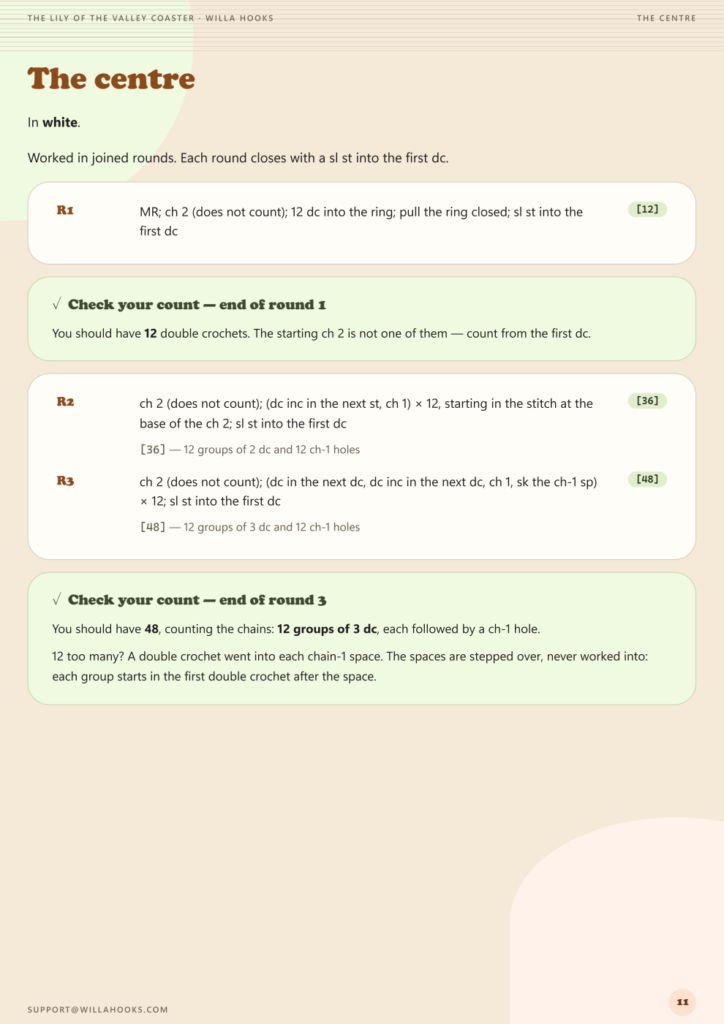
That box is the one place this coaster is easiest to get wrong. Round 3 is the first round that steps over the holes instead of working into them. So the box gives you the number you should have, 48, and then tells you what being exactly twelve over means: a double crochet went into each hole. This is page 11 of the coaster’s 19, and it is the same page you will be reading with a hook in your hand.

Reviews
There are no reviews yet.